
Question:
My husband is doing a lot of what he needs to do to repair our relationship. But I still cry all the time. Every little thing triggers me and I still see them together in my head. When will it stop? What is a realistic affair recovery timeline?
How Long Does Affair Recovery Take?
Most affair recovery experts agree that healing from infidelity typically takes between 1–2 years, although every relationship and person heals differently.
The early months are often the most painful due to betrayal trauma, obsessive thoughts, and emotional shock. Over time, triggers usually become less frequent and less intense — especially when both spouses actively participate in the healing process.
Healing is not linear, but with good support, most couples gradually experience greater stability, hope, and emotional peace.
Answer:
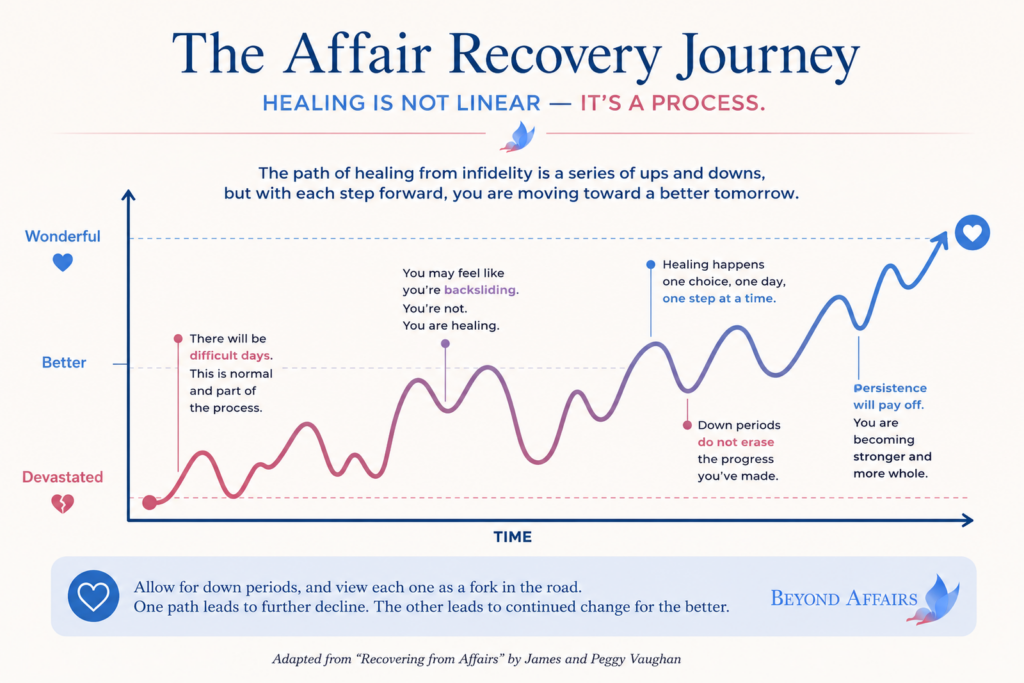
Affair recovery experts generally agree that it takes a minimum of at least two years to heal. It took me 2.5 years.
The good news is we are seeing many couples heal in as little as a year. We’ve also noticed a common denominator among the couples that heal quickly; they are often the ones who found good help within the first couple of weeks following disclosure of the affair.
We’ve come to realize that it’s actually not always the affair itself that is the most difficult thing to heal from, but rather all the mistakes couples make after disclosure that often create even more damage to the relationship. The sooner you get good help, the better.
It can be discouraging to think it may take two years or so to heal, and sometimes hearing this causes people to think:
“We’ll never make it.”
“I can’t do this.”
It’s important to remember that while you may be asking, “How long does it take to heal from an affair?” things are getting better throughout the journey.
You do not spend two years at the same level of pain you feel in the first three months.
Healing and getting past the obsessive thoughts is gradual. Slowly over time, as you work on yourself and move through the healing process, the painful thoughts generally become fewer and farther between, and their intensity lessens.
One day you suddenly realize:
“Oh my God… I can’t remember the last time I even thought about the affair.”
That day eventually comes for many people.
At the same time, it’s important not to become rigid about timelines.
As one affair survivor told me:
“I’m sick and tired of people telling me exactly how long it should take me to heal. I just want to heal in my own way and in my own time.”
Considering how painful this journey is, I think she has a very valid point.
Another client once joked:
“As if I’ll suddenly be healed in two years, one month, five days, three hours, 47 minutes and 23 seconds!”
How ridiculous.
Yet many experts will confidently tell you it takes exactly “x” amount of time.
Who cares how long it takes as long as you actually do heal?
As long as you are continuously moving forward?
On the flip side, I also want to clarify that when we say healing often takes a minimum of two years, that does not mean the entire two years are intensely painful.
You can still enjoy:
- happy moments
- laughter
- good memories
- vacations
- intimacy
- dates
- meaningful connection
along the way.
During our own healing journey, my husband and I had many intimate conversations where the honesty was refreshing and actually brought us closer together.
At times we intentionally “put the affair on hold” and simply enjoyed being together. That’s important.
If the spouse who had the affair is sincerely doing their part — facing the betrayal honestly, answering questions, rebuilding trust, and giving their partner what they need to heal — the relationship cannot survive two full years of nonstop negativity and interrogation.
Intentional emotional breaks are healthy.
People who heal themselves and their marriages after affairs — and who eventually become even stronger and happier on the other side — usually find healing requires a combination of things.
It often includes:
- reading books
- counseling
- honest conversations
- support groups
- retreats or seminars
- personal growth work
- accountability
- learning new relationship skills
No one source gives you everything you need.
And one thing is absolutely certain:
Time alone does not heal affairs.
It’s time plus doing the right things.
Affair Recovery Timeline
Day 1 — Disclosure: Devastated
Whenever I used to watch reruns of the footage of 9/11 and the Twin Towers collapsing one story into another until nothing was left but rubble at ground zero, it triggered me.
It reminded me symbolically of my own personal ground zero.
The day I discovered my husband’s affair, it felt as if everything I believed about my life — my values, hopes, dreams, memories, and sense of safety — collapsed in a single moment.
The life I thought I had no longer existed.
Maybe you can relate.
Phase 1: The First 3–6 Months — The Trauma Phase
During the first 3–6 months, many betrayed spouses experience symptoms similar to PTSD (post-traumatic stress disorder).
Common symptoms include:
- shock
- panic
- obsessive thoughts
- inability to focus
- difficulty sleeping
- loss of appetite
- emotional flooding
- constant triggers
- fear
- confusion
- hypervigilance
This phase often feels unbearable.
Many people wonder:
“Will I ever feel normal again?”
At this stage, survival is the priority.
Take it:
- one moment
- one hour
- one day
at a time.
Don’t pressure yourself to imagine being “healed” yet.
It’s difficult to see the ending when you are just beginning.
But let me reassure you:
You can survive this.
You will make it through this.
Phase 2: The Next 3–6 Months — The Fighting Phase
Or perhaps more accurately:
“The Facing the Real Issues Phase”
If both spouses are willing, many couples find it wise to genuinely explore whether healing and reconciliation are possible before making permanent decisions.
Doing so often helps people move forward later without regrets, knowing they truly tried.
By this point:
- the initial shock has lessened somewhat
- affair fog may begin lifting
- reality starts setting in
- deeper conversations begin
If the unfaithful spouse ended the affair completely and sincerely early on, real healing work can finally begin.
This phase often includes:
- difficult conversations
- emotional honesty
- conflict
- grief
- anger
- accountability
- learning healthier communication
If a couple leans into the healing work with the right guidance and tools, this stage can produce enormous growth.
It’s difficult.
But it’s also where real rebuilding begins.
Phase 3: 6 Months–1 Year — The Hope Phase
By now, much of the most intense trauma has settled.
You are still hurting.
You are not fully healed.
But many couples begin to experience something incredibly important:
Hope.
If both people are consistently doing the work, you may begin to see light at the end of the tunnel.
You start realizing:
“Maybe we actually are going to make it.”
Triggers still happen.
Anniversaries and reminders can still be difficult.
But healing is becoming more stable.
This phase can also become a time to start addressing marital dynamics and relationship weaknesses.
However, it’s extremely important not to say:
“The affair happened because of problems in the marriage.”
That is not accurate.
There are no perfect marriages.
No perfect wives.
No perfect husbands.
If we search hard enough for flaws in the marriage that “caused” the affair, we will always find something.
The problem is:
affairs happen in good marriages too.
The truth is, in marriage we will all get it wrong sometimes.
I need to know that when I get it wrong, my husband will still get it right.
Phase 4: Better — But It Still Hurts (1 Year & Beyond)
For many couples, this is when healing becomes more emotionally stable.
The affair no longer dominates every waking moment.
Triggers become:
- less frequent
- less intense
- easier to recover from
Many people begin feeling:
- stronger
- wiser
- calmer
- emotionally healthier
- more grounded
This does not mean forgetting the affair.
You will likely never forget it.
Healing means:
the affair no longer controls your emotional life.
Phase 5: Almost — But Not Quite Healed (2 Years & Beyond)
At this point, many people are mostly healed, but still experience occasional sadness or lingering trust sensitivity.
Certain things may still trigger you:
- songs
- movies
- commercials
- social media
- unexpected reminders
You may occasionally have a “bad day” that feels discouraging.
Usually, you are not actually moving backward.
It’s simply part of grief recovery.
Don’t panic when it happens.
Don’t fight it.
Move through it gently.
Lingering questions may still come up from time to time, and it’s generally healthiest to continue having honest conversations rather than shutting them down.
One thing that greatly helps during this stage is ongoing reassurance from the spouse who acted unfaithfully.
Things like:
- consistency
- emotional safety
- accountability
- transparency
- affection
- reassurance
- continued personal growth
all continue helping trust stabilize over time.
What does not help is saying things like:
“Aren’t you over this yet?”
“You should be healed by now.”
That lacks compassion and often creates setbacks.
Final Thoughts
Please remember:
Time alone does not move people through affair recovery.
I’ve met couples 30 years after an affair who still feel emotionally frozen at the moment of discovery because true healing work never happened.
The wife still cries.
The husband still hangs his head in shame.
Thirty years passed.
But emotionally, they never moved forward.
Don’t let that become your story.
Get good help.
Face this honestly.
Lean into the healing process.
Because true healing is possible.
And finally:
never pressure your spouse by saying:
“You should be farther along by now.”
Healing takes the time it takes.
What Does It Mean to Be Healed?
Healing does not mean forgetting.
You will probably always remember what happened because betrayals this large permanently become part of your life story.
Healing means:
when you remember it, it no longer overwhelms you with deep emotional pain.
Your story transforms:
from one of devastation…
to one of survival…
to eventually one of strength, wisdom, and victory.
Frequently Asked Questions About Affair Recovery
Can a marriage fully recover after infidelity?
Yes. Many marriages not only recover after infidelity, but eventually become stronger, healthier, and more emotionally connected through the healing process.
Why do triggers still happen years later?
Triggers are normal after betrayal trauma. Certain memories, songs, movies, or situations may briefly reactivate painful emotions even years later.
Is it normal to still think about the affair every day?
Yes. During the early phases of recovery, obsessive thoughts are extremely common. Over time, these thoughts usually become less frequent and less emotionally intense.
What helps affair recovery happen faster?
Couples who heal most successfully typically:
- get good help early
- maintain honesty
- answer questions openly
- stay emotionally engaged
- pursue personal growth
- avoid minimizing the betrayal
- create accountability
- remain committed to healing over time
Learn More
Related Articles
Healing a Marriage After an Affair: 9 Essential Steps
10 Strategies for Surviving Infidelity
Rebuilding Trust After Cheating and Infidelity: Healing, Accountability, and Affair Recovery
Ready for More Personalized Help?
If you’re looking for more than information and want experienced, personal guidance, our three-day Healing from Affairs retreat has helped thousands of couples rebuild trust, restore hope, and heal after infidelity.