
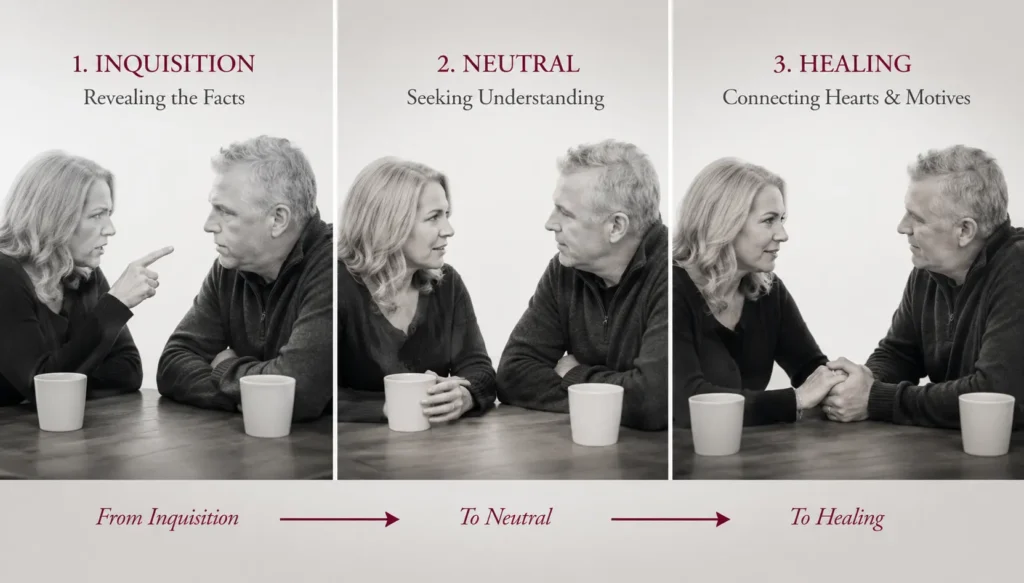
One of the biggest challenges couples face after infidelity is figuring out how to talk about the affair.
At first, conversations often feel painful, repetitive, and emotionally explosive. The betrayed spouse desperately wants answers. The unfaithful spouse feels attacked, ashamed, defensive, or overwhelmed. The same arguments happen over and over again, and both people leave the conversation feeling frustrated and misunderstood.
What many couples don’t realize is that these conversations tend to evolve through predictable stages.
Understanding these stages can help you be more patient with yourself, your spouse, and the healing process.
Stage One: The Adversarial Truth-Seeking Inquisition
The first stage of disclosure is what I call the adversarial truth-seeking phase.
This stage is characterized by heightened emotions, accusations, anger, fear, and a desperate need for answers.
The betrayed spouse often feels like a detective trying to uncover the truth. The unfaithful spouse often feels like they are on trial.
Questions may sound like:
- How could you do this to me?
- What were you thinking?
- Why wasn’t I enough?
- How many times did it happen?
- What else aren’t you telling me?
This stage is normal.
After betrayal, people need answers. They need to understand what happened and regain a sense of reality. There is also a legitimate need to express anger and pain.
However, couples who remain stuck in this stage for too long often struggle to make meaningful progress.
While emotional expression is healthy, ongoing attacks, accusations, or destructive expressions of anger rarely lead to healing.
Stage Two: Neutral Information-Seeking
As emotions begin to settle, couples often move into a second stage.
Instead of trying to prove a point or win an argument, the focus shifts toward understanding the facts.
The betrayed spouse still has questions, but the questions become more curious and less accusatory.
The goal becomes understanding rather than confrontation.
This stage allows both spouses to begin making sense of the affair story together.
It is often during this stage that important details emerge, misunderstandings are corrected, and both people begin seeing the situation more clearly.
Many couples spend considerable time moving back and forth between stages one and two.
That’s normal.
Healing is rarely a straight line.
Stage Three: A Healing Exploration
The third stage is where the deepest healing occurs.
This stage is characterized by cooperation, empathy, curiosity, and a shared desire for understanding.
Instead of viewing each other as opponents, the couple begins exploring difficult questions together.
The conversation shifts from:
“Who is right?”
to
“What happened, and how do we heal?”
This is where genuine breakthroughs occur.
The betrayed spouse becomes more interested in understanding their partner’s internal experience.
The unfaithful spouse becomes more willing to share honestly and vulnerably.
Both people become less focused on defending themselves and more focused on understanding each other.
This stage does not excuse the affair.
It simply creates the conditions where real healing becomes possible.
Why Couples Move Backward Sometimes
One of the biggest mistakes people make is assuming that once they reach a healthier stage, they will stay there permanently.
That isn’t how healing works.
You may have a productive, empathetic conversation one day and find yourself angry and reactive the next.
Many factors influence our ability to engage difficult conversations:
- sleep
- stress
- physical health
- work pressures
- parenting demands
- unresolved grief
- emotional triggers
A difficult day can make affair conversations much harder.
Developing self-awareness helps.
Sometimes we think we are responding to the affair when, in reality, exhaustion, stress, or overwhelm are amplifying our reactions.
Progress doesn’t require perfection.
It requires continuing to move forward.
The Meanings We Attach to the Affair
One of the most important breakthroughs in affair recovery happens when betrayed spouses begin examining the meanings they have attached to the affair.
Many people naturally conclude:
- I wasn’t enough.
- I was rejected.
- I was replaced.
- I didn’t matter.
- My spouse stopped loving me.
While these interpretations are understandable, they are not always accurate.
The meanings we attach to an event often create additional suffering.
If we want to truly understand what happened, we eventually need to become curious about our spouse’s experience rather than assuming we already know what it meant to them.
This can be incredibly difficult.
But it is often where healing begins.
Ask Better Questions
Many betrayed spouses unintentionally ask questions that already contain assumptions.
For example:
Why didn’t you love me anymore?
The problem is that the question assumes the unfaithful spouse stopped loving their spouse.
Yet many unfaithful spouses report continuing to feel love, attachment, and commitment toward their spouse while simultaneously engaging in behavior that violated their values and damaged the marriage.
A more productive question might be:
What were you feeling toward me during the affair?
Or:
What was happening inside you at that time?
Open-ended questions create understanding.
Leading questions often create defensiveness.
The goal is not to validate the affair.
The goal is to understand what actually happened.
Understanding Does Not Mean Excusing
Many betrayed spouses fear that empathy means excusing the affair.
It doesn’t.
You can fully acknowledge that the affair was wrong while also seeking to understand what was happening inside your spouse.
In fact, understanding often helps couples rebuild trust because it allows them to address the real issues rather than arguing about assumptions.
One of the most important lessons I’ve learned through my own marriage and through years of coaching couples is this:
People often interpret the same event very differently.
My husband Brian and I frequently laugh about this now.
We can attend the same workshop, sit side by side all day, and take completely different notes.
If you compared our notebooks afterward, you might think we attended different events.
Human beings experience the world through different filters.
If we want to understand our spouse, we must be willing to listen to their experience rather than assuming it matches our own.
Healing Conversations Create Healing Marriages
Talking about an affair is never easy.
There will be tears.
There will be setbacks.
There will be days when it feels impossible.
But couples who successfully recover learn how to move beyond accusation and defensiveness toward understanding and empathy.
The goal is not simply to talk about the affair.
The goal is to use those conversations to create deeper understanding, greater honesty, and ultimately a stronger marriage.
That is where healing lives.
Frequently Asked Questions
Is it normal to ask the same questions repeatedly after an affair?
Yes. Repetition is common as the betrayed spouse tries to make sense of what happened and integrate new information.
Why do conversations about the affair keep turning into arguments?
Many couples are still operating in the first stage of disclosure, where emotions are understandably intense and both spouses feel misunderstood.
How can I ask better questions after infidelity?
Focus on open-ended questions that encourage understanding rather than questions that assume motives, intentions, or feelings.
Can an unfaithful spouse still love their partner?
Many people report continuing to feel love and attachment toward their spouse while engaging in behavior that was deeply harmful to the relationship.
How do we move from anger to understanding?
Healing usually occurs gradually as both spouses develop emotional safety, honesty, empathy, and a willingness to understand each other’s experiences.
Learn More
6 Stages of Affair Recovery & Healing After Infidelity
Related Articles
Does Talking About an Affair Help Healing?
When Your Spouse Won’t Answer Questions About the Affair
Next Step in Recovery
Rebuilding Trust After Cheating & Infidelity: Healing, Accountability and Affair Recovery